
Before You Spend Heavily on CMMC, See What Hackers May Already See
A plain-English starting point for threat-informed CMMC readiness. See what may make you look risky, what to validate first, and what to fix before spending money on tools, documentation, or assessment prep.
Start with a Free Security Check
A few seconds of public-information review. Use it before you spend money on CMMC tools, documentation, or assessment prep.
Check Your Domain Exposure
Passive review only — we never touch your network
✓ Free preview • ✓ No credit card • ✓ Results in seconds • ✓ Email must match domain (e.g., you@company.com for company.com)
Outside View:
-This is a quick preview. The CMMC Cyber Snapshot expands on these findings in plain English — what to protect, what may make you look risky, and what to fix first — and is the starting point for a CMMC advisory conversation.
Talk Through My Results →What the CMMC Cyber Snapshot answers
The CMMC Cyber Snapshot is a practical starting point for small DoD contractors preparing for CMMC. It helps leadership answer three questions before spending money on tools, documentation, or assessment prep:
- What do we need to protect? A plain-English view of likely CUI touchpoints to validate with leadership.
- What could make us look risky to a prime? Visible signals a prime, buyer, or contracting team could notice before a conversation starts.
- What could make us an easier target for hackers? Leaked credentials, weak email security, exposed systems, and similar signals.
The Snapshot uses passive public information to surface what matters before a prime, assessor, or attacker ever speaks with you. It is not a CMMC assessment, certification, or penetration test — it is a clearer starting point for CMMC readiness.
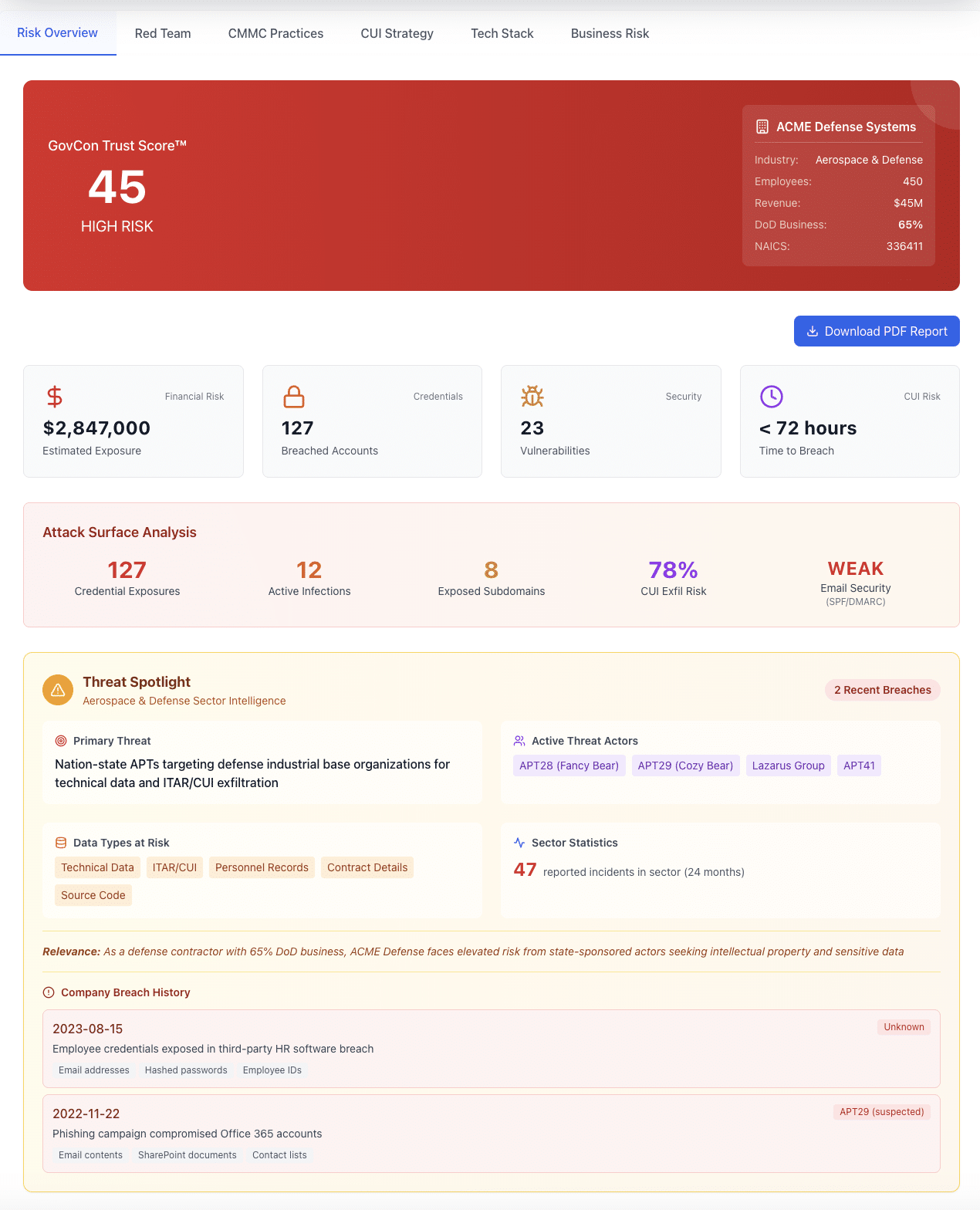
How an attacker might connect the dots from public information
We walk through the same kind of outside-in review an attacker (or a prime's risk team) could perform. The goal is to show what is visible — not to test or touch your systems.
Illustrative scenario only. These are fictional example values, not HostBreach findings about a real organization. No compromise or control effectiveness is established.
[FOUND] DoD contract signals found. Review FCI, CUI, and flowdown requirements.
[INTEL] Scanning breach databases for employee credentials...
[INTEL] Querying infostealer log marketplaces...
[INTEL] Enumerating subdomains and shadow infrastructure...
[SIGNAL] dev.contractor.com still reachable from the internet
[SIGNAL] Executive email found in known credential lists
System Boundary → Review what's reachable from the outside and trim the scope
Communications → Fix email authentication so the company is harder to impersonate
What we look for
Plain-English findings drawn from public information — what a prime, assessor, or attacker could see without ever touching your network.
Leaked credentials and infostealer signals
Employee credentials surfaced in known breaches, plus signs of infostealer malware that captures session cookies — the kind of access that can bypass MFA.
Identity & AuthenticationEmail spoofing risk
SPF, DKIM, and DMARC posture in plain English — whether someone could send mail that looks like it came from you, and what that means for phishing against your team or partners.
Communications IntegrityExposed systems and forgotten subdomains
Dev environments, old portals, and infrastructure that may still be reachable from the internet — common starting points that warrant review of ownership and CUI relationships.
System BoundaryVisible vulnerabilities that may matter now
Externally visible issues prioritized by real-world exploitation likelihood — not a 500-line CVE list. The handful actually worth looking at first.
System IntegrityPeople and roles that may be easier to target
Program managers, engineers, and executives whose public footprint makes them obvious targets for spear phishing — the people most likely to touch CUI.
Awareness & TrainingProvider and technology signals
Visible MSP, cloud, and identity providers that could shape CMMC scope. We help leadership think through whether a limited CUI enclave or broader organization-wide approach fits how CUI actually moves through the business.
Scope & ProvidersContext, Not Just Data
We don't bombard you with vulnerability lists or meaningless IOCs. We show leaders why findings matter to your business.
Not This
"You have 847 CVEs across your infrastructure"
Raw vulnerability counts without context just become noise — and noise is not a decision.
We Deliver This
"A handful of visible issues matter most right now — here's why they affect your CMMC path"
A short list of fixes leadership can actually act on, in plain English.
Not This
"127 employee emails found in breach databases"
A breach count alone doesn't tell leadership which exposure actually matters or where to start.
We Deliver This
"These are the roles most likely to handle CUI and most likely to be approached — start here"
Findings tied to the people, providers, and decisions that shape your CMMC path.
How an attacker might connect the dots
An outside-in walkthrough — no testing, no touching your systems. We trace how visible signals could line up into an attack path, so leadership can decide what to address first.
What's visible
Domains, providers, people, and infrastructure a stranger can find without ever touching your systems.
Where it gets risky
Leaked credentials, weak email security, or forgotten systems that turn public information into a potential access opportunity.
Who could be targeted
The roles most likely to handle CUI and most likely to be approached by phishing or social engineering.
What to address first
The short list of fixes that quietly reduces attacker opportunity and informs internal scoping decisions.
How the Snapshot supports threat-informed CMMC readiness
Findings are mapped to relevant CMMC Level 2 control areas so leadership can decide on scope, priorities, provider questions, and the shape of a readiness roadmap — before money is committed.
Relevant CMMC L2 control areas
- Access Control (AC)
- Identification & Authentication (IA)
- System & Communications Protection (SC)
- System & Information Integrity (SI)
- Configuration Management (CM)
- Risk Assessment (RA)
- + 8 More Domains
SCOPE Enclave or broader CMMC effort?
We help leadership think through whether a limited CUI enclave or organization-wide approach makes sense based on how CUI actually moves — providers, people, systems, and contracts — not a single revenue percentage.
PRIORITIES Which visible issues should we fix first?
The short list — leaked credentials, weak email security, exposed systems — that addresses both attacker opportunity and CMMC control areas at the same time.
PROVIDERS Which provider decisions affect scope?
MSP, cloud, identity, and email choices that quietly expand or shrink CMMC scope. The Snapshot surfaces the visible signals so the right questions get asked early.
LEADERSHIP What should leadership understand first?
A clearer view of the picture before spending money on tools, documentation, or assessment prep — and a starting point for the next CMMC advisory conversation.
What it is not
Clear about scope so leadership knows exactly what they're getting.
Not a C3PAO Assessment
The Snapshot does not certify CMMC compliance and does not replace a C3PAO assessment.
Not a Penetration Test
No active testing, no probing, no touching your systems. Public information only.
Not a Certification
No badges, no scores that count toward CMMC. This is a clearer starting point, not a stamp.
Not an Affirmation
We don't sign off on controls or affirm compliance. Findings are recommendations, not attestations.
Frequently Asked Questions
Common questions about the CMMC Cyber Snapshot
Will this touch our network?
No. The CMMC Cyber Snapshot is a passive review of public information. We never scan your systems, install agents, or access your internal network.
How long does it take?
The free quick check returns in seconds. The full Snapshot review and advisory conversation happen within days, not weeks.
Is this a CMMC assessment?
No. The Snapshot is a clearer starting point for a CMMC readiness conversation. Findings map to relevant CMMC Level 2 control areas — they are not compliance affirmations, and they do not replace a C3PAO assessment.
Can I share the report internally?
Yes. The Snapshot is built to be readable by leadership. Many companies use it to align internally before deciding on scope, providers, or assessment timing.
What if we're not a DoD contractor?
We also offer a Cyber Intel Snapshot that maps to frameworks like SOC 2, HIPAA, and PCI-DSS. Contact us for details.
How is this different from a pentest?
A pentest actively probes your systems. The Snapshot doesn't touch anything — it reviews what's already visible from public information so leadership can decide what to address first.
CMMC should make you easier to trust and harder to attack
Start with the free quick check. Then we can talk through what the results mean for your CMMC path.
The CMMC Cyber Snapshot is a practical starting point for small DoD contractors preparing for CMMC Level 2. HostBreach uses passive public information to give leadership a plain-English view of what needs to be protected, what may make the company look risky to a prime, and what to fix first — before money is committed to tools, documentation, or assessment preparation. Findings are mapped to relevant CMMC Level 2 control areas to inform scope, priorities, and provider decisions. The Snapshot is not a C3PAO assessment, a certification, or a penetration test. HostBreach provides CMMC readiness and advisory services for DoD contractors handling Controlled Unclassified Information (CUI).
HostBreach is a threat-informed cybersecurity advisory firm providing CMMC and vCISO services powered by its proprietary Cyber Intel Engine.
External observations require internal validation. They do not independently determine CMMC requirements, scope, compliance, compromise, or insurance coverage.
Threat-Informed CMMC Advisory · Threat-Informed vCISO · Our intelligence layer
DC3 threat reporting · Official CMMC Level 2 assessment guidance